Choose one kind of miss
Aiming practice is easier to judge when you identify a particular problem. You might move past stationary targets, struggle to follow a moving target or fire before the crosshair settles. Those problems need different drills. Pick one rather than treating every missed shot as evidence that the mouse settings are wrong.
Use a game's practice area or another supported training mode where possible. Keep the same sensitivity, field-of-view settings and input device for the drill and the game. A separate trainer can be useful, but settings with the same number do not necessarily produce the same movement across applications. Check the conversion method before assuming a direct match.
A short routine you can repeat
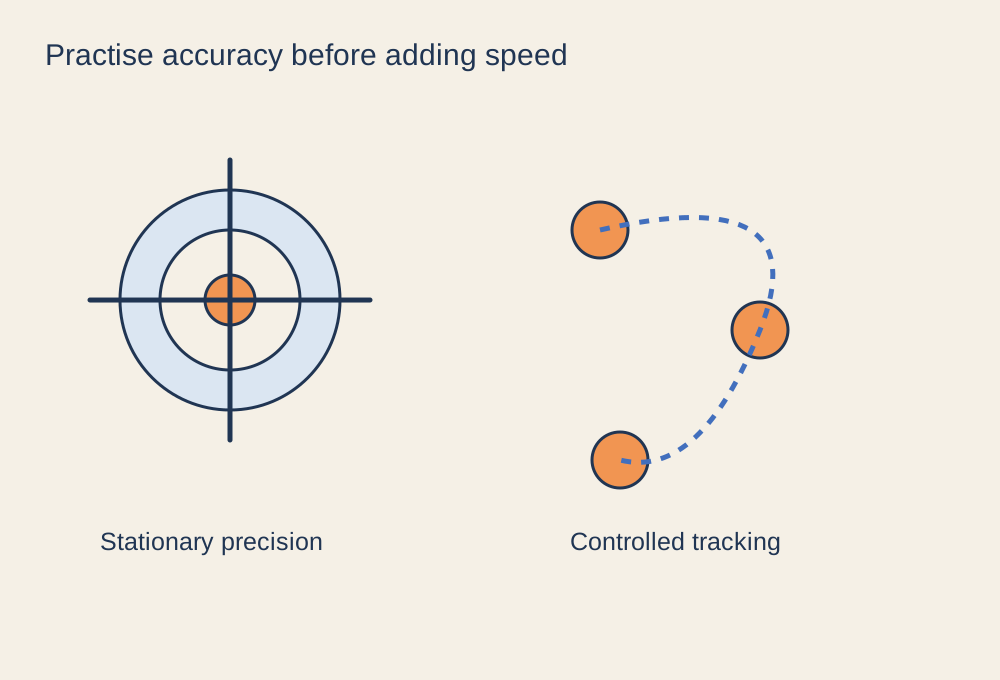
Begin with slow movements between stationary targets. Aim to stop on the target deliberately, then increase speed only while control remains consistent. For tracking practice, follow a moving target smoothly rather than making repeated large corrections. Keep each block short enough that you can concentrate on the movement rather than simply accumulating minutes.
An example session might use two minutes to settle into the controls, three minutes of stationary precision, three minutes of tracking and a short review. That is a suggested structure, not a proven training prescription. Adjust it to the game's mechanics and stop if you feel discomfort or find attention fading. More time is not automatically more useful practice.
Carry one observation into a match
Record a simple observation such as overshooting to the right or losing track after changing direction. Compare similar attempts under the same conditions. Do not change sensitivity after every disappointing score; frequent changes can make the results difficult to interpret. If an adjustment seems necessary, change it deliberately and give yourself time to judge it.
Remember that aiming is only part of a game. In VALORANT, for example, the official beginner guidance discusses movement and firing accuracy, so a stationary drill does not replace learning when to stop moving. Other games have different movement, recoil and projectile behaviour. Practise those rules in the actual game rather than assuming that every shot works like a trainer target.
Finish by playing a short ordinary mode with one focus in mind. Review whether the chosen movement felt more controlled, not only whether you won. Positioning, information and decisions influence the result too. A useful routine gives you a specific thing to notice; it does not promise a rank increase after a fixed number of days.